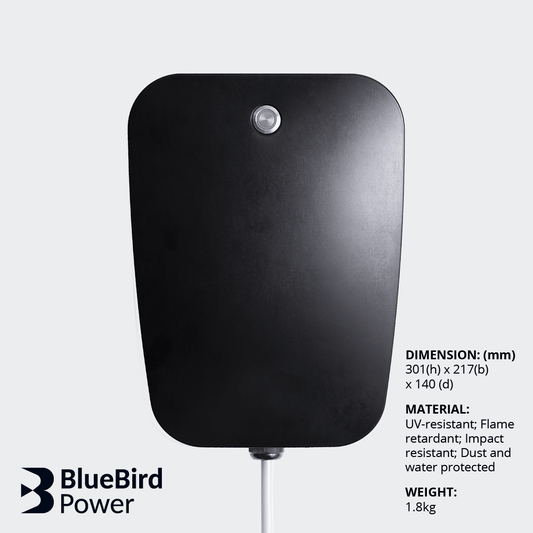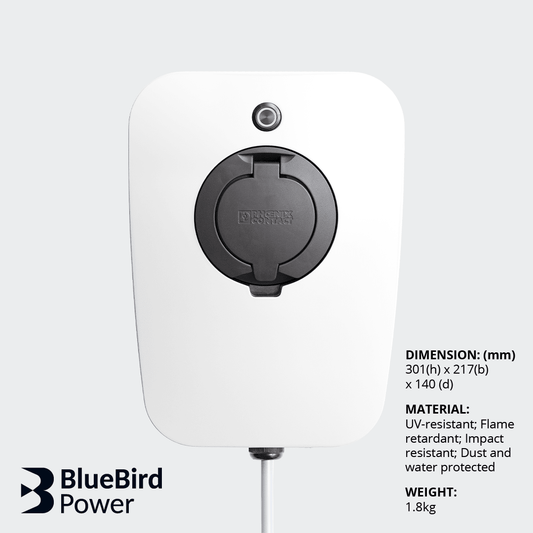

BlueSky charger obtains MID certification
Great news: BlueBird Power has obtained MID certification for the BlueSky chargers!
This certification is relevant for commercial billing, but also for registering Emission Reduction Units (ERE certificates, Emissie Reductie Eenheden). Since January 1st 2026, private individuals with a charger that has a built-in MID meter can sell these ERE's through a registration service provider (inboekdienstverlener), and earn money from charging at home. We've previously written this article about these ERE's.
In this article, we take a closer look at the MID certification we obtained and the financial value of ERE's for a BlueSky customer with an average charging volume.
MID certification
MID stands for Measuring Instrument Directive, a European standard from 2014. Energy meters used for financial transactions, such as the MID meter in a charger, must meet this standard and pass all the associated tests. Unfortunately, there isn't yet a separate standard for electricity meters in chargers, so chargers have to pass the same tests as, for example, the electricity meter in your meter cupboard. As a result, chargers also have to pass tests that, in practice, are completely irrelevant to them. For example, 1,000 hours (more than 40 days) of continuous charging in a 55°C oven.
BlueBird Power passed all of these tests with flying colours at the Netherlands Metrology Institute (NMi). See the photos below of several EMC tests. EMC stands for Electromagnetic Compatibility. This checks both whether the electricity meter (in our case, the entire charger) is resistant to electromagnetic interference from outside, and whether it causes no interference of its own.
NMi told us that we're the first charger manufacturer to pass all EMC tests in one go!

EMC test at a specialised EMC lab in England.

EMC test in the NMi lab.
Value of ERE certificates for an average customer
The value, or ERE rate, of an ERE certificate is determined by market forces, within the boundaries set by government regulation. Fuel suppliers have a legal obligation to reduce the CO2 emissions of the fuel they supply each year: the Fuel Transition Obligation (Brandstoftransitieverplichting). This reduction is calculated across the entire chain, from extraction of the raw material through to combustion in the vehicle, and measured against a fixed European reference value. For the road transport sector, which includes home chargers, this obligation rises from 14.4% in 2026 to 28.4% in 2030. This means fuel suppliers' CO2 emissions must be 28.4% lower in 2030 compared to this reference value.
To meet this obligation, fuel suppliers blend in biofuel or hydrogen, or buy ERE's from parties who can demonstrate they've supplied renewable energy for transport. Since the 1st of January 2026, this renewable energy can also come from home chargers with an MID meter. Important to know: electricity on the grid is not 100% green, it's a mix of wind, solar and fossil sources. Because it can't be traced exactly which electricity ends up in your charger, the ERE system uses a fixed national average, the grid average renewable share, which stands at 50.5% in 2026. So even if you have solar panels yourself, only this average counts, not your own generation.
We therefore have no influence over the value of the underlying ERE certificate, that's determined by market forces and changing regulation. What we do influence is the share of that value that reaches our customers. A share goes to the registration service provider, a small share to us, and 85% goes to you as the end customer. We simply make it possible to claim ERE's. The savings are yours.
For the administrative side, we work with Joulo. As a registration service provider, they register the energy charged through your MID charger with the Dutch Emissions Authority (NEa, Nederlandse Emissieautoriteit), pool the relatively small volumes from individual home chargers into tradeable quantities, have this verified, and sell the ERE's on the market.
A calculation example
An average customer charges around 3,000 kWh per year. At the current ERE rate of €0.13/kWh (net, after deduction of commission), that yields an ERE payout of over €390 per year, paid directly to you. That means the charger pays for itself in about a year and a half, even before taking into account the extra savings from price optimisation and using surplus solar power. Because the Fuel Transition Obligation rises year after year, the value of ERE's, and with it your savings, is generally expected to keep rising in the coming years. This is an expectation, not a guarantee: the ERE price depends on multiple factors, so it could also turn out differently.
The ERE registration process
At the time of writing (September 2026), more than 100 registration service providers are registered with the NEa. Strict requirements apply to how charged kWh's are registered: the total registration may not contain more than a 2% error margin. If a larger error margin is found, for example due to something going wrong in data processing, there's a risk the entire registration is rejected and nobody receives their money.
A reliable data integration is therefore essential to guarantee the quality of registered sessions, and maintaining such an integration with 100+ parties at once is impossible. That's why we'd rather choose quality over quantity, and work with one selected registration service provider: Joulo. According to us, they're the most reliable partner when it comes to IT systems and automation of the verification steps, and they achieve a high ERE payout for our customers.
To make signing up as easy as possible, you'll soon be able to sign up for ERE registration directly through the BlueBird Power app. You'll then be redirected straight to the right environment within Joulo, where you link, among other things, the bank account you'd like your payouts to be sent to.
Good to know: you can only be registered with one registration service provider at a time. Duplicate registrations are, of course, rejected by the NEa. Registration happens per calendar year, retroactively from the 1st of January, which is why the minimum contract term with a provider is one calendar year. Some providers only pay out the following year, while we, via Joulo, pay out every quarter.
Already have an arrangement with another registration service provider, for example through your energy supplier? Then we recommend switching to the direct Joulo connection: it's automatic and more secure, instead of having to upload an export of your charging sessions yourself each time. Switching is possible per calendar year: check with your current provider about the notice period (often around a month before year-end) and sign up from January 1st via the BlueBird Power app.
Still partway through your current contract year? You can still take participate with your BlueSky charger: through the app, you can create an export of your charging sessions, which you then upload yourself to your current provider's system. Note: not every provider accepts this way of submitting data, as it's considerably more error-prone than the direct connection we offer via Joulo.